mod-languages_DESC


We Help Operations Managers to Conceive and Actualize Their Industrial Visions Based on the Lean Manufacturing Culture

We Help Operations Managers to Conceive and Actualize Their Industrial Visions Based on the Lean Manufacturing Culture


All Our Blogs
In order to start the Kaizen improvement process, the following elements are essential:
1. The clear separation between what is considered "value" and what is considered "waste" within the given context.
2. The knowledge of the 3 types of family waste: Muda, Muri and Mura.
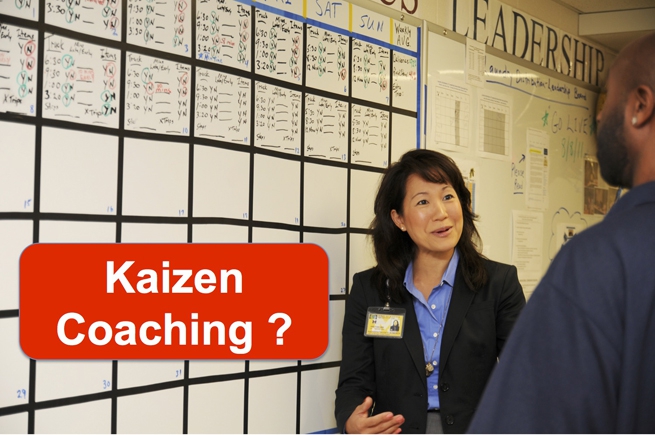
Lean Manufacturing and Kaizen Coaching
In the world of Lean Manufacturing, we frequently hear about coaching.
Unfortunately, I have found that there is still a great deal of confusion about coaching and its activity. It is often confused with consulting, mentoring, or training.
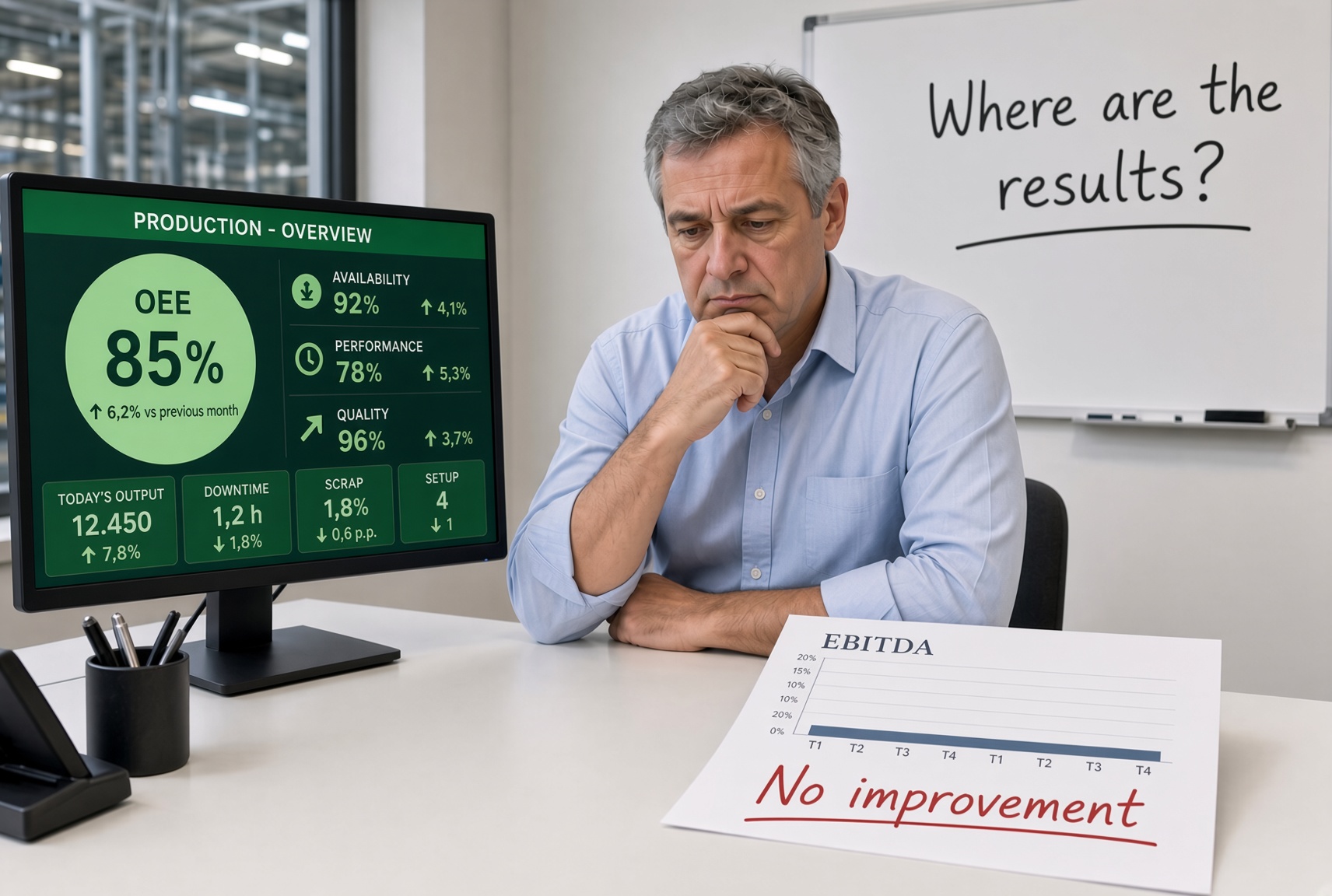
You took OEE from 68% to 85%.
The production team is celebrating. The dashboards are green. The weekly reports show positive trends.
Then comes the meeting with the CFO.
"Margins are flat. Cash flow hasn't improved. Inventory is still high. Where are the results of all this lean work?"
And you don't know what to say.
Not because you're not working hard. But because the link between OEE and the P&L is not automatic. And nobody ever explained it clearly.
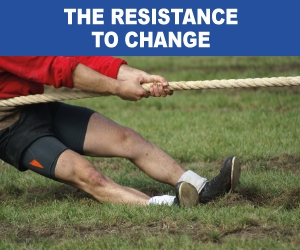
In the company, it is possible to see the force of resistance to change at work just as soon as new ideas which in fact question the entire hierarchy, are introduced.
The resistance to change is much stronger the closer you get to the vertex of the company pyramid.

You know the moment. The strategy slide deck lands in the inbox: twenty pages, color-coded, with phrases like “alignment cascade” and “transformation roadmap”. People nod in the meeting. Three months later, nobody can name a single priority on the deck without scrolling back to find it.
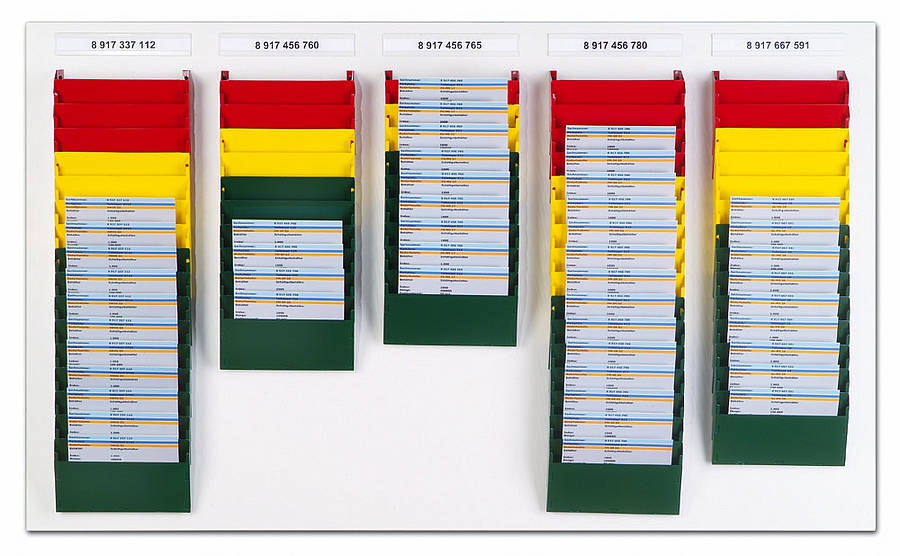
Kanban is a Japanese word meaning “signal”.
But what kind of signal?
Most of the time, this type of signal indicates two things:
1. It is time to supply.
2. It is time to produce.
Why was it invented?
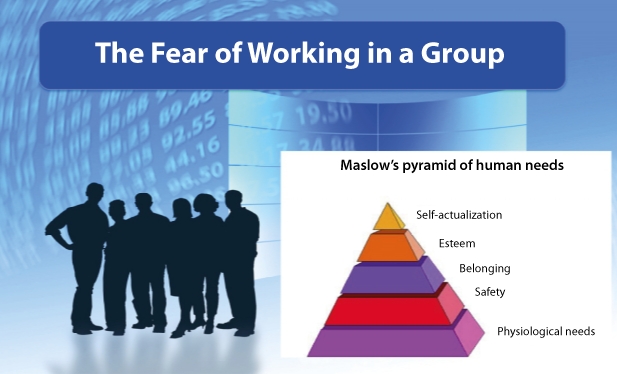
Lean Manufacturing and the Kaizen philosophy of continuous improvement are based on work groups. It is not possible to implement WCM or TPM if we are unable to manage and promote teamwork.
What are the base conditions that a good Kaizen coach must create so that the group performs very well?

Problems don’t exist as fixed objects in the outside world.
Have you ever “tripped over” a problem?
No. It’s impossible. No one has ever found a 1 kg problem in the fridge. No one has ever literally placed a problem on a table. At most, anyone who did that — maybe in anger — was pointing at a physical object: a symptom of the problem, not the problem itself.
Have you ever thought to buy a new car?
Every time you identified the brand, color, and other details of pertaining to your choice, you began to see it everywhere around you. The things that you didn’t notice beforehand will be visible from now on.
If we study the various graphic representations of the Toyota Production System, Just in Time, TPM and WCM, it is possible to notice that in these models there is always the recall at the involvement of all the company people.
The neverending improving work is done to get rid from wastes and to improve the value aggregation in work activities and this is the daily focus of a company that follow the Lean Production paradigm. This work can be done efficiently and with a R.O.I. only if the problem solvings workshops are always done with a 360° vision and opennes attitude about the analyzed problems; this is the basic attitude that is required and it is necessary to develop in a lean team work.

Our Blogs