mod-languages_DESC


We Help Operations Managers to Conceive and Actualize Their Industrial Visions Based on the Lean Manufacturing Culture

We Help Operations Managers to Conceive and Actualize Their Industrial Visions Based on the Lean Manufacturing Culture


Blog
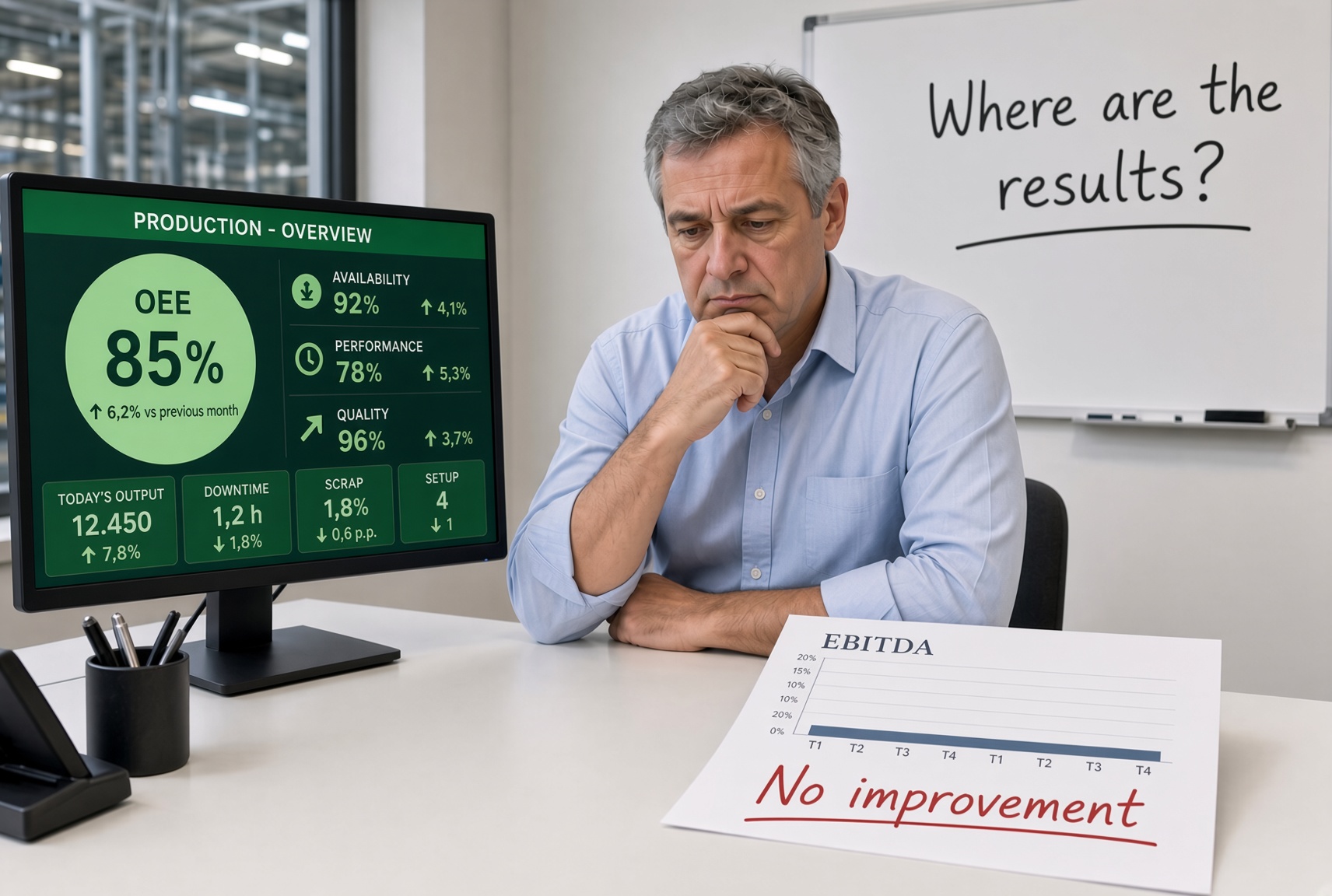
You took OEE from 68% to 85%.
The production team is celebrating. The dashboards are green. The weekly reports show positive trends.
Then comes the meeting with the CFO.
"Margins are flat. Cash flow hasn't improved. Inventory is still high. Where are the results of all this lean work?"
And you don't know what to say.
Not because you're not working hard. But because the link between OEE and the P&L is not automatic. And nobody ever explained it clearly.

You know the moment. The strategy slide deck lands in the inbox: twenty pages, color-coded, with phrases like “alignment cascade” and “transformation roadmap”. People nod in the meeting. Three months later, nobody can name a single priority on the deck without scrolling back to find it.

Problems don’t exist as fixed objects in the outside world.
Have you ever “tripped over” a problem?
No. It’s impossible. No one has ever found a 1 kg problem in the fridge. No one has ever literally placed a problem on a table. At most, anyone who did that — maybe in anger — was pointing at a physical object: a symptom of the problem, not the problem itself.
8 Steps for Boosting Productivity in Production Lines
1 📈 Mudas Detection
In this phase, all wastes related to the production line flow and the actual work standards are detected, evaluated, and prioritized. Lean manufacturing has categorized seven types of wastes that can be found in any workplace where operators are at work and another set of 16 wastes that can be detected only after a deep analysis of the production line data.
The 4 Steps Process To Create Accountability in The Workplace
The accountability concept is becoming increasingly prominent in big companies. These companies have many people, functions, roles, and tasks that should ensure the excellent performance of their working processes.
When managers hear these types of excuses:
- "That's the way we have always done here".
- "It wasn't my fault that it's late."
- "No one told me what to do."
- "Someone should have told me not to do that."
Collaborators are not puppets.
You can not expect them to achieve goals if you constantly micro-manage them. If you usually do this, you will end up frustrated and wasted time controlling them.
Stop continuously checking what, how, and when they are doing it, and suggest your ideas and solutions.
Do not inhibit them.
If you are micro-managing, it is because you do not trust them and do not trust because you missed some preconditions and missed setting some frames.
I often hear companies' collaborators complaining that they are in too many meetings.
By the way, today's business complexity brings a continuous flow of information that obliges managers and middle managers to continuously review, revise, and decide correctly what is necessary.
To do this, they need to be in meetings...
However, I think the real reasons why people are complaining are:
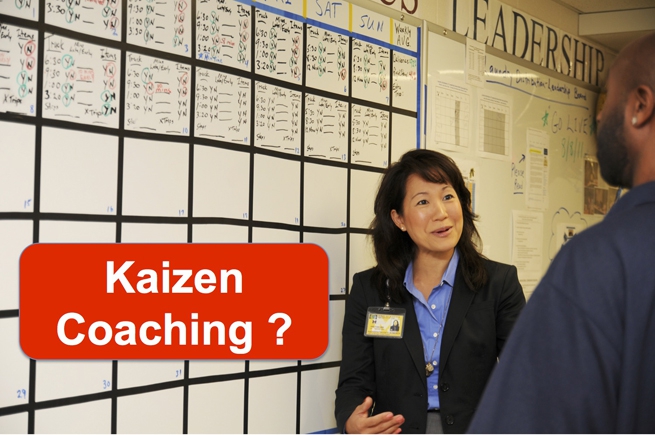
Lean Manufacturing and Kaizen Coaching
In the world of Lean Manufacturing, we frequently hear about coaching.
Unfortunately, I have found that there is still a great deal of confusion about coaching and its activity. It is often confused with consulting, mentoring, or training.
The Kaizen Executive Blog

Our other blogs