





For operations leaders who have tried Lean and seen results vanish three months later:
What if the problem isn't your team,
your culture, or your Lean tools,
but the way Lean was introduced?
Four plants. Four sectors. Four months. And every result was achieved by the client's personnel and that's exactly why it still lasts today.
THE QUESTION WORTH STOPPING ON
There's a question that separates the employees of companies that truly implement Lean from the employees of companies where Lean has become theater.
"Why should I, your employee, choose to implement Lean, instead of every other usual way of doing things I already have, including doing nothing new at all?"
When the answers fail, it's not because they're false: it's because they're not aligned with what your employees really think about Lean.
The inability to answer this question clearly is the beginning of Lean's disintegration.
And it's the most solvable problem in a company, once correctly identified.
THE PATTERN BEHIND EVERY LEAN PROGRAM THAT ISN'T DELIVERING RESULTS
 "The Lean system isn't broken. It's blind."
There's a pattern that repeats in almost all failed Lean programs in manufacturing.
It's not the tools. The tools work. Value stream mapping works. Standard work works. Daily management works. Kaizen works. You know it because you've seen them work: intermittently, for a few months, before the organization silently reabsorbed them into the old way of working.
The pattern is this: Lean was sold to you as a project. A consultant arrived, conducted workshops, built a roadmap, facilitated improvement events, and delivered a presentation. There was energy. There were whiteboards. There were indicators. Then the consultant left, and took the results with them.
What was never built is the right level of change.
There are 4 levels of change your organization must go through to reach a true culture of continuous improvement. The traditional Lean consultant can't take you there: they can only take you to level one.
So you end up with a heavy Lean structure that delivers less than it should:
■ Operational KPIs that don't always move financial KPIs.
■ Inventory discussed in every meeting but never truly under control.
■ Overtime that has become normal.
■ Scrap and rework explained as technical problems instead of margin losses.
■ Plant managers defending their department while the company absorbs the damage.
A Lean organization that is credible on paper, but one that doesn't show up in EBITDA, working capital, or cash flow.
It's not your problem. It's not your team's problem.
It's what happens when Lean is done to an organization instead of being built by the people who run the plants every day.
Fill in the form at the bottom of the page to download the guide right away.
MOST COMPANIES BELIEVE THE PROBLEM IS IMPLEMENTING LEAN BETTER
IT'S NOT
WHY?
The real problem is that Lean tools improve processes, but rarely produce a permanent change in the behavior of the people who run them. That's why, when the project ends or the consultant leaves, the results slowly vanish.
Every Lean transformation must go through four levels of change. Traditional consultants, and most internal Lean managers, can take you only to level 1 of change.
In this special guide you'll find:
WHY YOU NEED TO CHANGE YOUR LEAN SYSTEM NOW
 Recently, during a Gemba Mirror Method™ day with a team engaged in a project stuck for more than 2 years, I asked a question structured according to GMM™. One person remembered a variation in operating mode that made it clear why the desired results weren't coming. The result was the unblocking of a 2 billion euro business. Two years of analysis hadn't succeeded. One question, asked at the right point, did.
Every quarter you carry forward improvement activities that don't move the P&L is one more quarter that brings the CFO closer to the question you don't want to answer in public.
The math is ruthless:
■ Excess inventory is trapped cash.
■ Overtime that has become normal is margin erosion.
■ Urgent transport is a planning error with a price tag.
■ Scrap and rework are margin losses disguised as technical problems.
They're not new problems. They're expensive problems that have been accepted as normal, and every month they remain normal, they add up.
You need someone on the ground, inside the real complexity of your plants, working with people to induce the reflections that truly change results.
Not a new project. Not yet another roadmap. A different way of building the system, with your people, so the results stay when the mental coaching ends.
DIAGNOSE AND BUILD YOUR NEW LEAN SYSTEM
DOWNLOAD THE GUIDE IN PDF
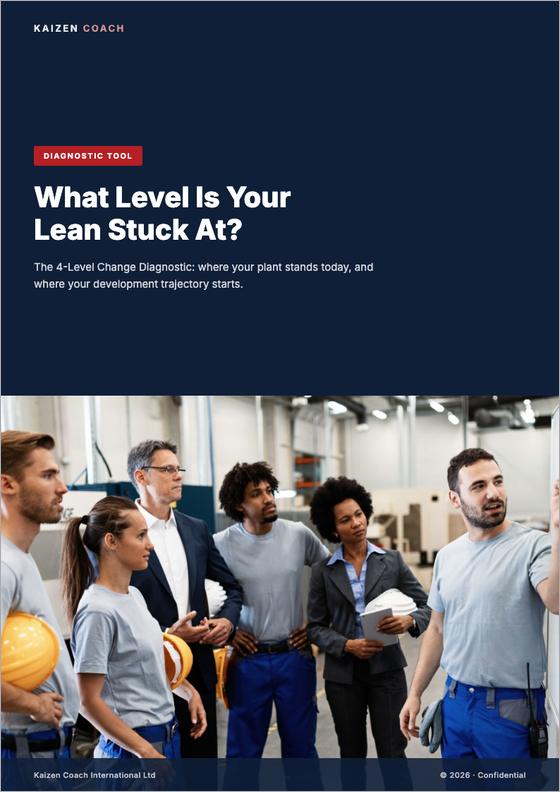
In this special guide you'll find not just the method: you'll find a guided diagnostic.
Once logged in, you can immediately run the 4-Level Change Diagnostic, illustrated in this guide: eight symptoms to rate from 1 to 5 to discover, in 10 minutes, which level your plant is stuck at and where your development trajectory starts.
WHAT YOU'LL FIND IN THIS SPECIAL GUIDE
To summarize, by leaving your name and email, on the next page you'll immediately find:
WHAT ELSE YOU'LL FIND IN THIS SPECIAL GUIDE
And there's more. On the reserved page, you'll also get:
To download this special guide, leave your name and email
No spam. Unsubscribe anytime. Your data stays private.