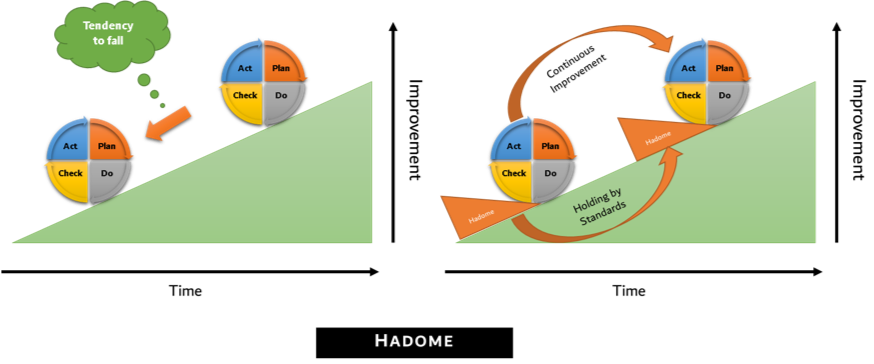
Japanese term Hadome ( 歯止め) means “brake”, “block” or “stop” movement or action.
In the framework of continuous improvement, apply the DEMING PDCA wheel. The word Hadomé is often spoken by your superior hierarchy following the solution of a problem. « So, have you ensured a hadomé to this problem? ». « Hadomé » literally means a brake or block, it is used to perennate the result obtained after the solution to the problem. In English, the word « wedge » illustrates well this important effect for the PDCA program.
For example:

Let’s assume you are going up a hill in your vehicle to enjoy nice weather. You are using force to climb up. suddenly your vehicle stops and as gravity applies vehicle starts moving down backwards. What we will you do?
First apply brakes to stop vehicle from further going down. At this stage you put vehicle on parking brakes, put a wedge or wheel choke at wheels, check the vehicle and start the vehicle to moving up again.

Hadome works as similar principal where PDCA wheel held in place on a slope improvement by a wedge or wheel choke is a common representation of Hadome is essential for Deming cycle.
What is Hadome in terms of PDCA Wheel?
Hadome is to essentially standardization of the process established after improvement have been made through PDCA Wheel or cycle process. So, now you can understand how standards are essential to sustains continuous improvement
Quick Recap What is PDCA? (See this term in the glossary)
Cycle of Improvement:
- Plan: Pinpoint an area for focus, and create an action plan,
- Do: Carry out the actions,
- Check: Verify the results and
- Act: Ensure level maintenance and continuous improvement.
Continuous Improvement Tends to fail if not properly standardize the process after implementation. Leaders must ensure and understand that after each continuous improvement cycle:
- Standardize the process
- Monitor the results carefully the process is sustaining at its place
- Then initiate a new cycle of continuous improvement.
The activity itself ensures long term growth and organizational progress in term of continuous improvement.
We recommend the training course: Structural Methods of Problem Solving