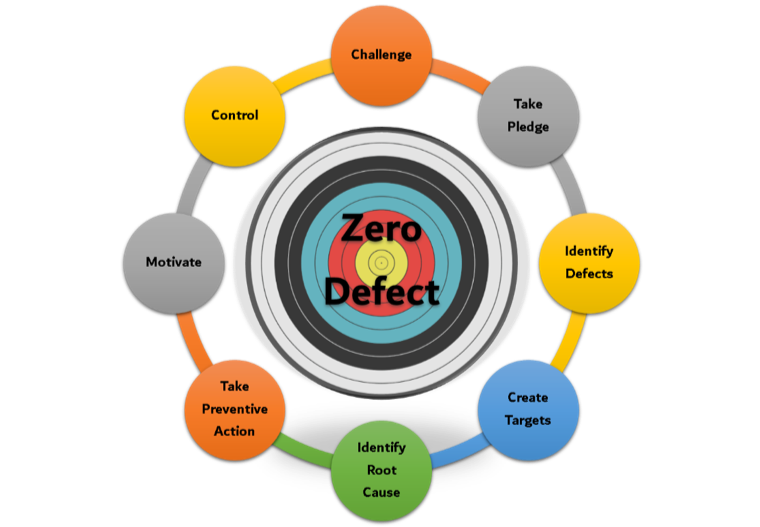
Zero defect is a concept that can be viewed as a quest of perfection to improve quality at minimum cost possible.
Zero Defect is a term coined by Mr. Philip Crosby in his book ‘Absolutes of Quality Management’. A defect can be defined as a non-conformance of a quality characteristic to its required specification. Thus, leading to waste which in return increases its cost of poor quality. Zero defect is a concept to ensure that ‘there is no waste existing in a project’.
The idea of Zero defects can be explained as that every employee should "do things right the first time."

Adopting Zero Defects:
- Zero defect concept is a top-down approach. Thus, the management of an organization should be committed to it.
- The top management needs to adopt the concept of Change Management. One must recognize that zero defects require significant change in the old ways the job was performed.
- Organization must understand the specifications to receive the quality as asked by the customer. Systems with zero defect concept should be designed where it is required.
- As Zero defects is a proactive approach, an organization should not wait till the defects occurs by itself.
- Organizations can form several “Quality circles” teams of workers or operator who are involve in production to identify defects and its causes.
- “Quality is Free” organization must understand the term and its value. “Cost of Quality” should not be greater than Production Cost.
- An organization should have a structure which helps it to receive continuous feedback of the operating systems. This helps to act quickly whenever any defect occurs.
- Building a structure of reward system when zero defect is achieved by the employees. This helps in motivating people towards quality conscious environment.
- Understanding that Zero defect concept is a continual improvement cycle system needs to adapt as per the changing requirements.
- Some suggested tools for adopting zero defects are Problem solving tools, 7QC tools Poka Yoke etc.
Implementing Zero defects comes with very good results like.
- Improved Customer Satisfaction.
- Less defect leads to less scrap (discarded product) and less repair or rework.
- Less cost investment in Quality Instruments and equipment.
- Less manpower required for inspections.
- Overall, lesser “Cost of Quality”.
- Reduction of waste and Cost of production.